Books are heavier than they look, and a shelf that looks fine on the day it is fitted can bow in the middle within a year. A good bookshelf starts with the books: their sizes, their weight, and whether they need protection from dust and humidity. The design follows from those.
Where Can a Bookshelf Go in a Flat?
- Living room: beside the TV, or as a full wall
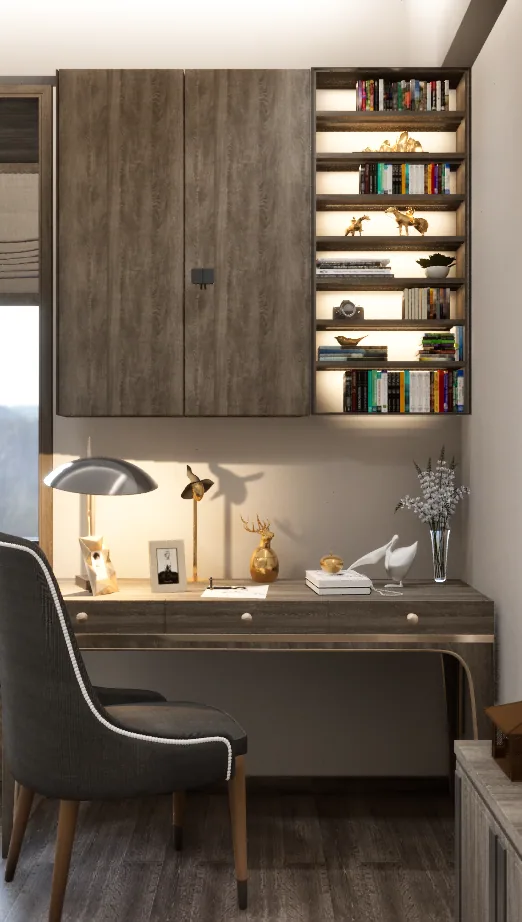
- Study: above or beside the desk
- As a partition between living and dining, open on both sides
- Passage or foyer, if the walkway is wide enough for shallow shelves
- Children's rooms, at a height children can reach
Our guide to partition design covers shelving used as a divider.
How Deep Should Bookshelves Be?
Just deep enough for your largest regular books. Too deep, and books get pushed to the back and lost; too shallow, and large books overhang. Most paperbacks and novels need far less depth than coffee-table books and files, so a mix of depths, or adjustable shelves, works best.
Space shelves for the tallest books on each shelf with a little hand room above. Adjustable shelf pins let you change spacing as the collection changes.
How Do You Stop Bookshelves From Sagging?
By limiting the unsupported span and using a strong enough shelf. The longer the shelf between supports, the more it bends under books.
- Keep shelf spans short, with vertical dividers at sensible intervals
- Use a thicker or stiffer board for longer shelves
- Add a front edge strip or a back support rail
- Fix shelves into the side panels, not only on pins, for heavy books
This is the most common bookshelf failure and the easiest to prevent at the design stage.
Open Shelves or Glass Doors?
Open shelves are easy to use and look lived-in, but collect dust quickly in Bengaluru, especially in flats near construction or main roads. Glass-fronted shelves keep books clean and still on display. For valuable or old books, closed or glass-fronted storage also protects against humidity.
A combination works well: glass doors on the lower, eye-level shelves for books, and open shelves higher up for display pieces that are easy to dust.
How Do You Protect Books From Humidity?
Avoid outside walls that take monsoon damp and walls shared with a bathroom. Leave a small gap between the back of the shelf and the wall for air. Use moisture-resistant board, and do not pack books tightly against the back panel. A dehumidifier or occasional airing helps in the wettest months.
How Do You Mix Books With Display Pieces?
Group books by height and colour, leave some gaps, and mix in a few objects at irregular intervals. A fully packed shelf looks like storage; a styled one looks like a feature. Lighting along each shelf makes a bookshelf glow in the evening.
What Should Be Decided Before Building a Bookshelf?
- How many books, and their sizes
- Location, away from damp walls
- Shelf depth, spacing and adjustability
- Spans and board thickness to prevent sag
- Open, glass-fronted or a mix
- Shelf lighting and its power point
Gunmala Interiors builds bookshelves as part of the woodwork. See our guide to work-from-home setups for shelves around a desk.
Frequently Asked Questions
How deep should a bookshelf be?
Just deep enough for your largest regular books. Too deep and books get lost at the back. Adjustable shelves or mixed depths suit most collections.
How do I stop bookshelves sagging?
Keep spans between supports short, use thicker or stiffer board for longer shelves, add a front strip or back rail, and fix shelves into the sides for heavy books.
Should bookshelves have glass doors?
Glass doors keep books clean from dust and protect them from humidity while keeping them visible. Open shelves are easier to use but need regular dusting.
Where should a bookshelf go?
In the living room, study, as a partition, or in a wide passage, away from outside walls that take damp and walls shared with a bathroom.
How do I protect books from humidity?
Avoid damp walls, leave an air gap behind the shelf, use moisture-resistant board, do not pack books tightly, and air the shelves in wet months.
Can a bookshelf be a room divider?
Yes. Open shelving between living and dining divides the space while letting light through. It must be fixed to floor and ceiling.
Should bookshelves have lights?
Shelf lighting makes a bookshelf a feature in the evening. Plan the power point before painting.
How do I style a bookshelf?
Group books by height or colour, leave some gaps, and add a few objects at irregular intervals.
Key Takeaways
- Design the shelf around the books: sizes and weight.
- Short spans and stiff boards prevent sag.
- Glass doors protect against dust and humidity.
- Keep bookshelves off damp walls, with an air gap behind.
- Mix books with a few display pieces and add shelf lighting.
See our guide to wall shelf design, or book a site visit.